LinkedIn hooks:
examples that stop the scroll.
The first line decides whether the rest of your post exists. Below: 28 original hook examples across seven types, with a note on why each pattern works — then how Linkziy keeps them coming.
14-day free trial · no credit card · cancel anytime
Seven hook types that earn the click.
Steal the structure, not the sentence. Each type below works for a different reason — pick the one that fits what your post actually delivers, then rewrite it in your own words. A hook that overpromises reads great and converts nobody.
Contrarian take
Why it works: Disagreement opens a loop — the reader stays to see if you can actually defend it.
Cold outreach isn’t dead. Lazy outreach is.
Your “personal brand” problem is actually a positioning problem.
Posting every day is the worst advice most creators ever follow.
Nobody cares about your product. They care about their Tuesday.
Number / result
Why it works: Specific numbers signal a real story is coming, not another platitude.
I reviewed 137 LinkedIn profiles last quarter. Three mistakes showed up in almost all of them.
One 40-minute change to our onboarding email did more than a quarter of feature work.
It took me 4 years to learn this about pricing. It’ll take you 2 minutes.
We ran the same offer with two different headlines. Only one of them booked calls.
Story open
Why it works: Starting mid-scene borrows the pull of fiction — the reader needs the missing context.
My first sales call as a founder lasted 6 minutes. The prospect hung up on me.
In 2021 I deleted my LinkedIn account. Last month it was my best channel.
The client fired us on a Friday. By Monday I understood why we deserved it.
I watched my cofounder rewrite our entire pitch in an airport lounge. It worked.
Question
Why it works: A sharp question makes readers answer it in their head — which means they’re already engaged.
When was the last time a cold message actually made you want to reply?
What would you post about if follower counts didn’t exist?
Would your ideal customer recognize themselves in your headline?
How many of your last ten posts would you have stopped scrolling for?
Mistake / lesson
Why it works: Admitting failure earns trust faster than claiming success — and readers lean in for the lesson.
I spent 6 months automating a process we should have deleted.
My biggest hiring mistake cost us a quarter. Here’s the question I never asked.
I used to end every post with a pitch. Then I read them all back in one sitting.
We doubled our posting frequency and halved our replies. Lesson learned.
List promise
Why it works: It sets the exact payoff and effort upfront — easy to commit to, easy to save.
5 LinkedIn profile fixes you can make before your coffee goes cold.
3 questions that will tell you more than any discovery-call script.
7 things I’d tell every founder writing their first 30 posts.
The 4 email subject lines I keep stealing from my own inbox.
Myth-bust
Why it works: It names a belief the reader might hold, then threatens it — hard to scroll past your own assumptions.
“The algorithm buried my post.” No — the first line did.
You don’t need to go viral. You need 200 of the right people to read you.
“Post at 9am on Tuesday” is not a strategy. Consistency is.
More followers won’t fix a feed full of posts written for everyone.
Hooks on tap, inside the editor.
The examples above are a starting kit. Inside Linkziy, a curated hook library lives one click from the post editor — filter by format and audience, pick a pattern, and fill in your angle. No tab-switching to a swipe file.
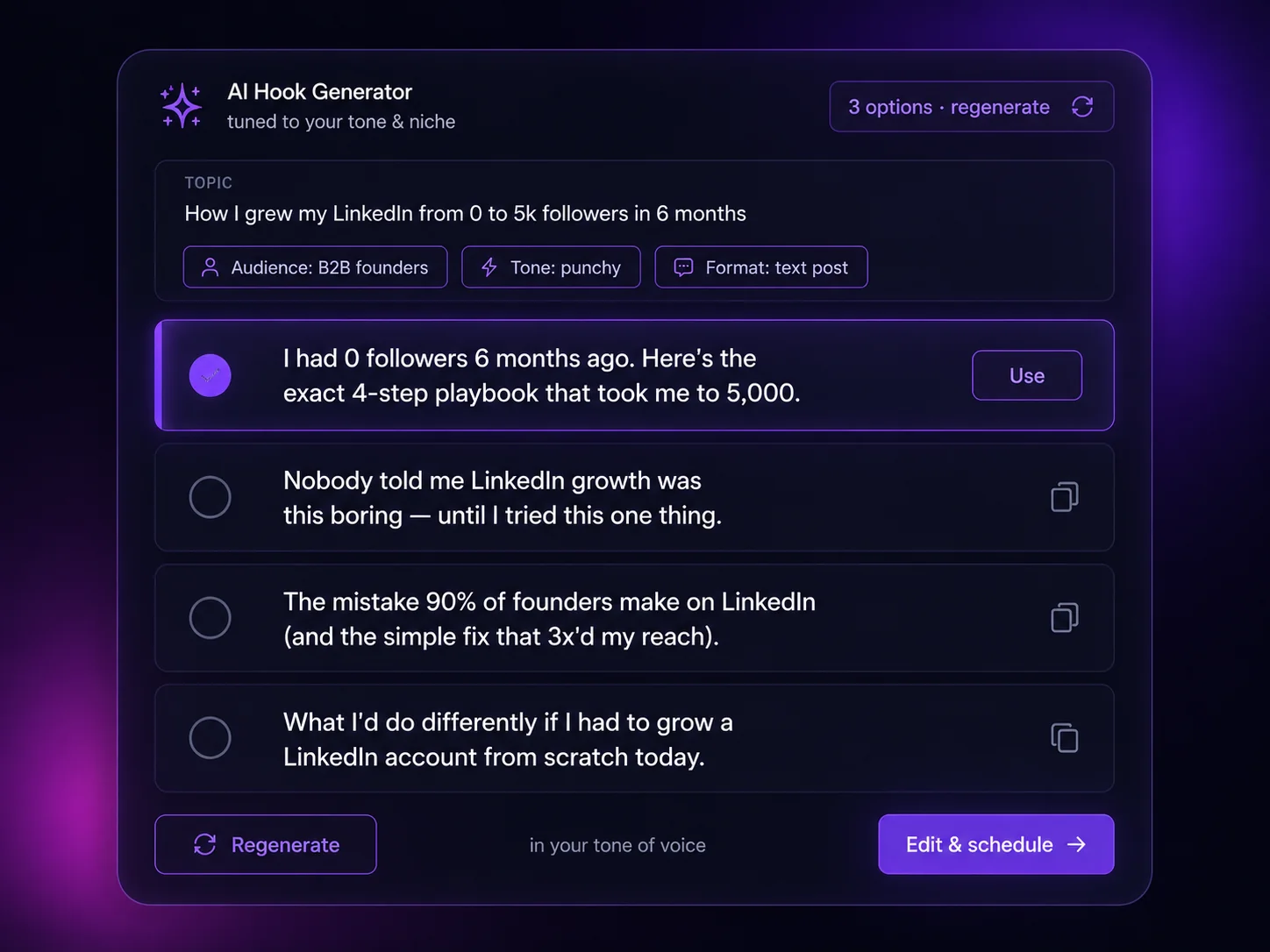
Then the AI takes over the repetition: give it your topic and it suggests several hook variants in your tone, so every draft starts from options instead of a blank first line. Turn the one you pick into a full post with the AI post writer, or make it the cover slide of a deck in the carousel builder — cover slides are hooks too.
Track which openers your audience responds to, and the winners feed your personal hook bank. For the research on why first lines carry so much weight, read the data behind viral LinkedIn posts.
A great hook is a habit, not a lottery ticket.
One scroll-stopping post changes nothing; thirty of them change who finds you. Queue your posts ahead in the LinkedIn scheduler so a strong opener ships every week, not just when inspiration shows up. The hook library ships as part of the AI module — from $9/mo, details on the pricing page.
Questions,
honestly answered.
Need something specific? Ask us directly — we answer during business days.
What is a hook on LinkedIn?
How long should a LinkedIn hook be?
Do hooks actually work on LinkedIn?
Your LinkedIn Growth OSis waiting.
Pick a hook type, let the AI draft variants in your tone, and ship a first line worth stopping for — every week.