What Is User Persona: Definition & Examples
Learn what user personas are and how to create them. Understand your audience better and build products and marketing campaigns that convert!

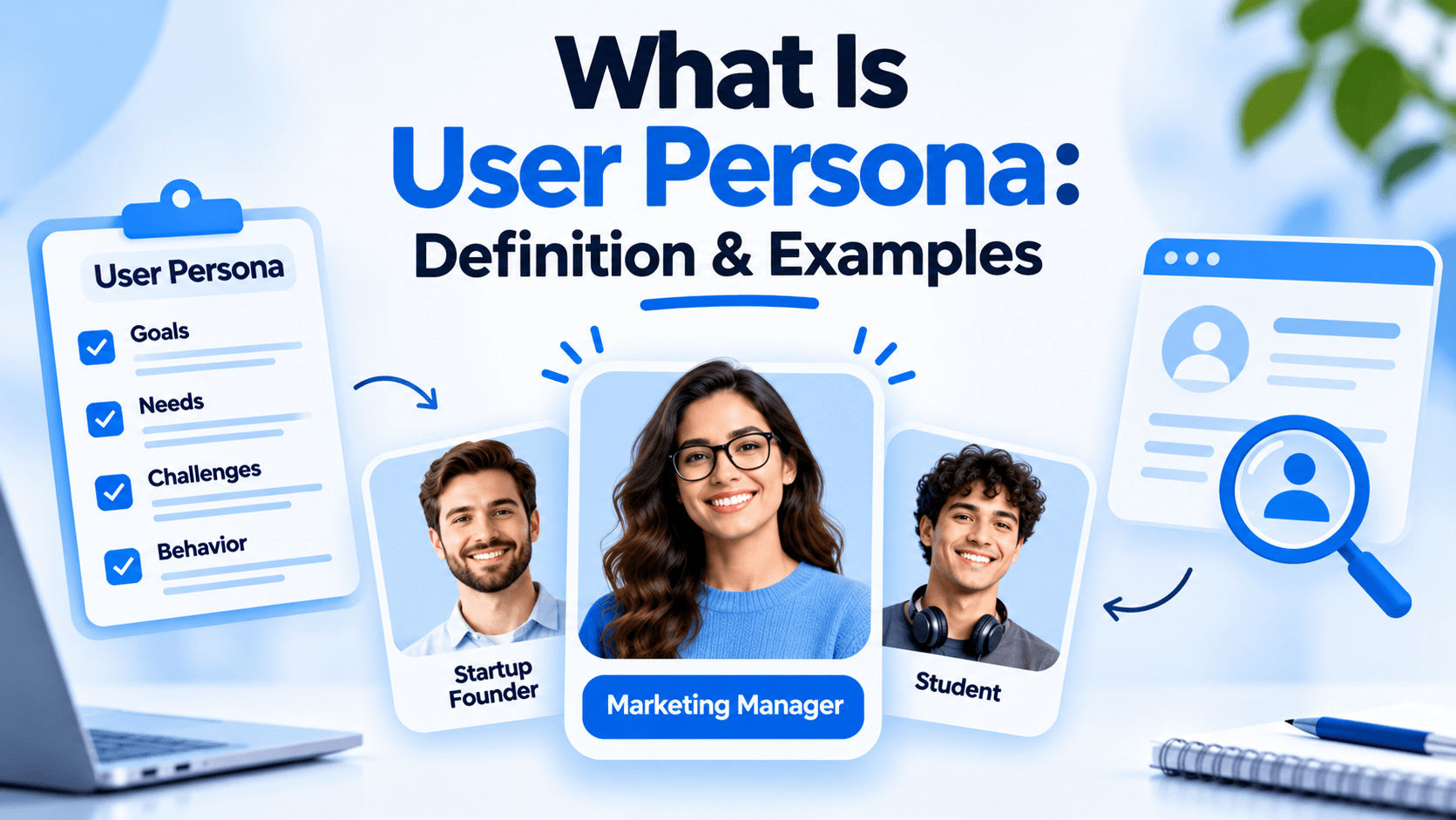
How well do you know that your consumers are using your product or service? The age or location or job title will tell you a little about them but not what they are in need of, what hurts them and why they will go with a solution yet not the other solution. A more in-depth insight into your audience will enable you to make superior products and more applicable marketing campaigns. It is where user personas come in handy.
They assist you in transforming research and customer understanding into lucid profiles that can lead to informed business choices. You need to learn about your users so that you can create experiences that will more efficiently match their needs whether you are creating an application or working on a website or planning a marketing campaign.
What Is a User Persona?
You may be asking yourself what a user persona is, it is a fictional description of a specific group of users which is based on research and description of the group of users that have similar goals, behavior, needs and challenges. It is not an individual user group, but a segment of users.
You do not make any assumptions about your audience but do use the interview and surveys of your customers, product analytics and feedback to identify any common trends. Then you use those insights and build a profile which enables your team to know who your users are and what they would want to accomplish.
A user persona usually comprises:
- Goals and motivations: What users strive to get.
- Difficulties and pain points: Issues that complicate those goals.
- Behaviors and preferences: The way users research, interact and use products.
- Relevant background: Occupation, experience or technical knowledge when this information is important to the needs of the user.
This is not meant to produce a detailed fictional biography. It is in order to make user research realistic enough to make daily decisions.
Why Are User Personas Important?

Through the knowledge of your users, you will determine better decisions in terms of product features, web content, communication with and marketing to your users.
Personas provide an overview of the people attempting to serve the audience to various teams.
The following are three valuable advantages:
- Better Product and UX Decisions: User personas assist you in determining whether a design or feature addresses a real user problem. All you have to do instead of designing around preferences is to focus more on functionality that enables the achievement of the goals of your audience and facilitates their experience.
- More Relevant Marketing: By finding out what motivates and causes challenges to your audience, you can create content and campaigns that meet their actual needs. This makes it easy to choose the appropriate messaging, communication channels as well as calls to action.
- Stronger Team Alignment: The personas can be used by your product, design, sales and marketing teams in making decisions. This minimizes conflicting assumptions and will assist in making everyone concentrate on providing value to the target audience.
User Persona Examples
An examination of the example of user personals would aid you in realizing how research converts into real-world personals. The below are fictional profiles illustrative. Evidence of your users should be used as the basis of your own personas.
1. E-commerce Shopper
Persona: Priya, the Practical Shopper
Priya is a busy professional who does a lot of shopping online and would wish to make sure she makes buying choices that are sound yet do not waste a lot of time comparing products.
- Purpose: To locate appropriate products at a fair rate in minimal time.
- Friction: Vague product specifications, additional charges, and complex checkout procedures.
- Behaviour: Reviews, price compares and verifies delivery details before purchase.
The opportunities can be offered to an e-commerce business with the help of this persona, which is oriented at the description of products, visible pricing, and with the help of easy checkout.
2. SaaS Product User
Persona: Daniel, the Time-Conscious Team Manager
Daniel works with a small team and uses project management software to organize work, track its conditions and ensure that projects are organized.
- Purpose: Enhance the visibility of the team and minimize the time wasted in the process of updates which is manual.
- Pain point: Difficult dashboards and tools which are highly configured.
- Behaviour: Likes one-way work streaks, helpful integrations and understandable reporting.
These findings will help a SaaS company review and streamline the onboarding process, simplify navigation, and demonstrate how its features can ease the real workflow challenges.
3. B2B Prospect
Persona: Sarah, the Sales Development Manager.
Sarah manages a sales development team, and she desires to find suitable prospects with an outreach being straightforward and personalized.
- Purpose: Identify good leads and develop substantial business contact.
- Pain point: Diffused prospect data, lots of manual work and irregular follow ups.
- Behavior: Makes use of professional networks, conducts research on potential customers and considers tools that can facilitate prospecting.
In the case of a B2B business, a persona will be able to steer messaging, content and prospecting processes based on the specific issues Sarah is facing instead of generic sales information.
How to Create a User Persona
The practice of designing practical personas requires research, analysis and continual improvement. These are a few of the procedures that you must observe to come up with profiles that reflect your readers and not your hopes.
Step 1: Gather User Research
Start with collected customer response, which can be in the form of interviews, surveys, feedback forms, support conversations, and product analytics. In a place where there are a number of sources, have them to familiarize yourself with what people say and how they behave.
Step 2: Find out the Patterns.
Identify common objectives, frustrations, likes, and behaviours. Divide group users sharing common needs into valuable subsets. Do not establish different characters due to minor differences that are not fundamental to either product or marketing decisions.
Step 3: Build Your Persona Profiles
Name each persona and give it a summary, note down its goals, area of pain, and behaviour, and background. Add information that will aid your team in making decisions and not unnecessary personal information that will fill the profile.
Step 4: Apply and Update Your Personas
Plan improvements in your product, write content, create customer journeys, or build campaigns using your personas. Check them out as you get to know new research, develop new changing customer needs or product updates and realize that what you have been knowing is not accurate.
Common User Persona Mistakes to Avoid
Even good intending personas may not work as well when not based on research. Watch out for these common mistakes:
- Possibility of assumptions: Prove what works with actual evidence of a customer.
- Focusing only on demographics: Prioritize goals, behaviours, and motivations.
- Developing unnecessary personas: Concentrate on valuable user segments that make a difference.
- Not updating profiles: Refresh personas with changes in your audience and product.
Conclusion
User personas enable you to know who you are dealing with in your customer data, and make decisions that reflect the needs of your users. Whether it is research, practical examples, and constant updates, you will be able to produce more productive products, enhance customer experiences, and produce more pertinent marketing campaigns.
In case you target users as a company, with potential customers who may be business customers and business people, another important step is to reach the right individuals.
Linkziy is an all-in-one Linkedin Automation Tool that unites LinkedIn prospect sourcing, outreach programs, content creation, and conversation management.
Browse through the webpage of Explore Linkziy to get an idea of how LinkedIn growth tools can help you in prospecting and reaching out to the required audience after you have identified your audience.