What Is Lead Generation in Sales? [2027 Edition]
Discover what lead generation in sales means and how to attract the right prospects. Explore proven ways to find better leads and boost sales!

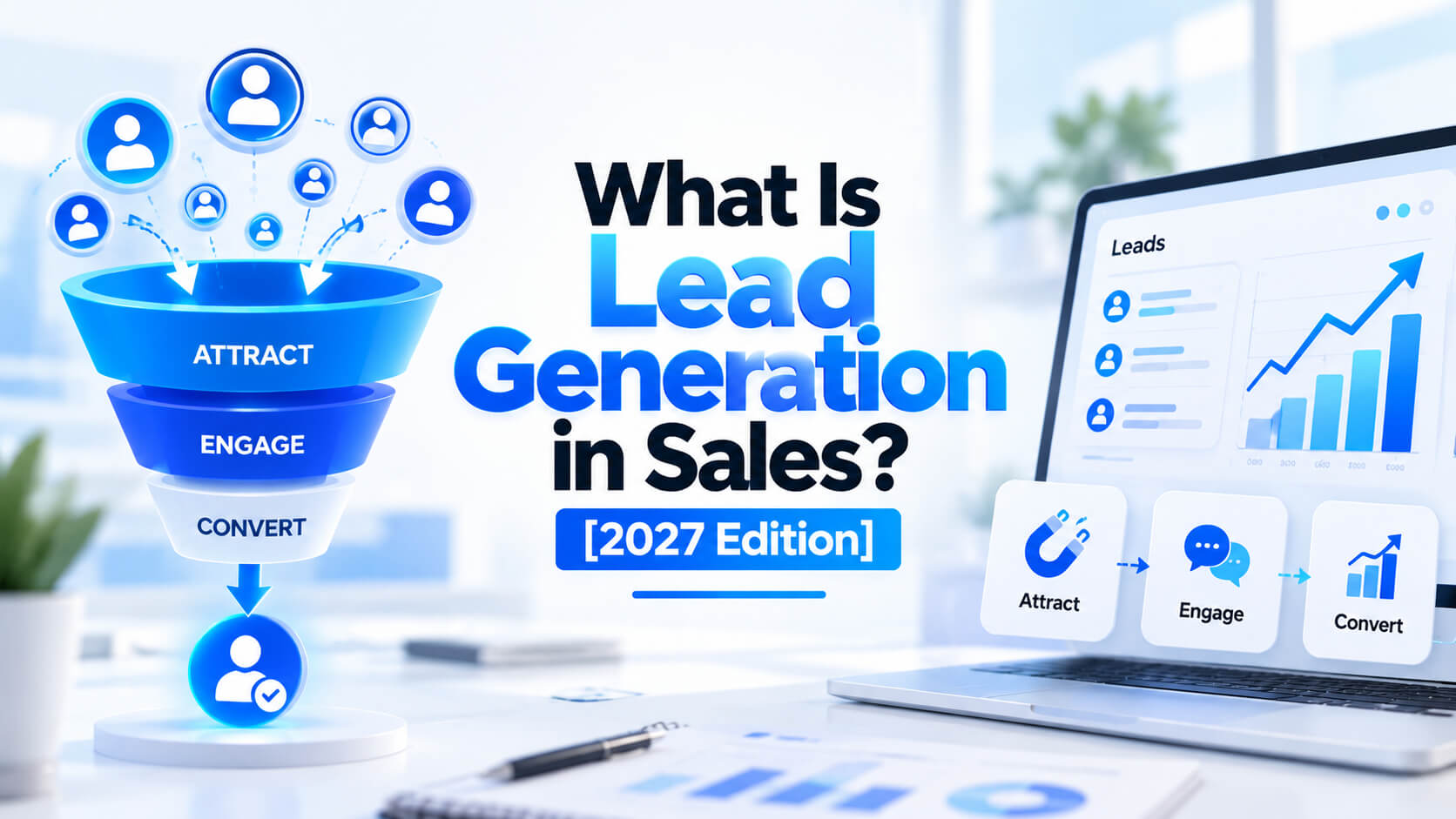
Sales become harder when teams spend time pursuing customers unlikely to buy. So what is lead generation in sales?
Lead generation helps sales teams find, attract, and engage prospects who may become clients. In sales, think of lead generation as the mechanism that translates market interest into real sales prospects.
As we look forward to 2027, it’s less about maximizing connections and more about engaging the right individuals with the appropriate messages.
What Is Lead Generation in Sales?
Lead generation is the process of recruiting prospective customers, gaining their attention, and engaging the right prospects in a sales discussion. A lead might come from a website form, a webinar, a recommendation, email, or social contact and outreach.
It's quality, not quantity. A name on a contact list is not a valuable lead by itself. The sales process is more efficient when you know who the ideal customer profile is and who is ready to have a discussion.
- Inbound Lead Generation
Inbound lead generation is the act of attracting prospects to a firm via content and discoverability. You may use blogs, SEO, webinars, newsletters, social media, and downloadable materials to attract folks who are researching an issue.
- Outbound Lead Generation
Outbound lead generation is the process of a company identifying the right prospects and then reaching out directly to them using channels such as LinkedIn, email, phone, events, and account-based outreach. It is feasible to identify individual prospects to target and to modify the message.
What Is the Lead Generation Process?
If you are wondering what is lead generation process is, it is a sequence that starts with defining your audience and continues until qualified prospects are ready for sales follow-up.
- Define Your Ideal Customer
This is identifying the firms and individuals who are most likely to profit from your offers. Industry, firm size, location, role, business challenge, purchase authority, and time. This means you are looking at the correct possibilities.
- Find and Capture Relevant Leads
Your inbound lead generation teams may use content, SEO, social media, and events to bring prospects to your website or newsletter. Inbound teams may source prospects from LinkedIn, Sales Navigator, databases or recommendations. You have to choose the channels where your customers hang out.
Once a prospect has entered your pipeline, it is important to acquire enough data to determine their fit. Score leads based on lead scoring, engagement history, job position, and contact enrichment. Salesforce advises defining your ideal customer profile and qualifying criteria to assist the sales team better qualify leads.
- Nurture and Qualify Leads
Not every lead is ready to purchase right away. Depending on what the prospect is most interested in, one may employ appropriate follow-up, case studies, product material, demonstrations, emails or LinkedIn chat.
Qualifications help you to separate the wheat from the chaff. The idea is to concentrate efforts and move the correct leads through the process, not chase every possibility in your database. The correct lead qualifying criteria should assist to find the most potential possibilities.
What Is a Sales Funnel in Lead Generation?
When you ask what is sales funnel in lead generation is, it is a funnel that guides prospects from initial awareness to purchase. Salesforce separates the lead generation funnel and the sales funnel, in that the former is more focus on gathering and qualifying interest.
- Awareness Stage
This is the apex of the funnel as the prospects are gaining knowledge of an issue or your brand. The initial impression can be created with the help of educational material, exposure to search, social mentions, events, and outbound marketing.
- Consideration Stage
At this point, the prospect is examining their options. They will view product sites, download material, react to outreach, and ask inquiries. It is here that nurture and qualification are more applicable.
- Decision Stage
Want a demo, a prospect may desire a proposal, consultation, or a price discussion at the bottom of the funnel. You need to work on value, fit, objections, and next steps, sales guys. A structured funnel also enables one to know where leads are being lost.
How Can LinkedIn Support B2B Lead Generation?
B2B sales with LinkedIn are productive as your potential clients are already linked. Zendesk in particular identifies LinkedIn, and outreach via direct email as one of the avenues that B2B organisations can pursue upon targeting a potential customer.
However, locating profiles, check fit, outreach, following up, and tracking replies may soon become inefficient when doing it manually.
- Start With Better Targeting
Before creating your prospect list, define which roles, industries, and company sizes matter, and which buying signals matter. More contacts don't necessarily mean more pipeline.
- Personalise Your Outreach
Stereotypical messages are easy to ignore. Apply pertinent details about a prospect such as his online profile, business, recent activity or even business setting to make your contact with them seem deliberate.
- Use the Right Lead Generation Tool for LinkedIn
A lead generation tool for LinkedIn can help you manage data collection, data enrichment, sequences, follow-ups, and reporting. The tool shouldn't replace good targeting or human judgment; it should make your workflow more consistent.
Conclusion
Lead generation is not concerned with stuffing your CRM with names. It involves establishing a repeatable channel between the correct prospect to an excellent conversation and ultimately to a genuine sales chance.
We have created our platform at Linkziy which is based on the LinkedIn growth workflow. You can scrape LinkedIn URLs, Sales Navigator searches, posts, groups, and events, add verified details to contacts, score prospects on ICP fit, and execute AI-personalised outreach sequences all within a single workspace. We also introduce replies to a single inbox and monitor meetings, pipeline activity, and attribution and combine outbound prospecting with LinkedIn content tools on our platform.
When LinkedIn plays a role in your B2B sales plan, Linkziy can be used to replace the disjointed process of prospecting with a more systematic approach of finding, reaching, and managing your potential buyers.
FAQs
Q1. What is the main purpose of lead generation in sales?
This is to find and contact individuals who can turn into customers so that your sales staff can work on what will be more productive opportunities.
Q2. What is the difference between a lead and a prospect?
A lead is somebody who has displayed possible interest or been recorded in your database. A lead is typically a prospect which has been evaluated further and seems to suit your target customer specifications.
Q3. Is LinkedIn good for lead generation?
This may be particularly applicable in B2B sales since you can filter by role, company and industry among other business filters then proceed to outreach.
Q4. Should you automate lead generation?
Targeting, message quality, compliance and human judgment are also important but can be automated when repetitive work, like data collection, enrichment, sequencing and follow-up, is involved.