What Is Lead Enrichment? The Expert’s Guide
Learn the meaning, types and benefits of lead enrichment. Turn incomplete data into sales insights and improve your outreach. Explore the guide now!

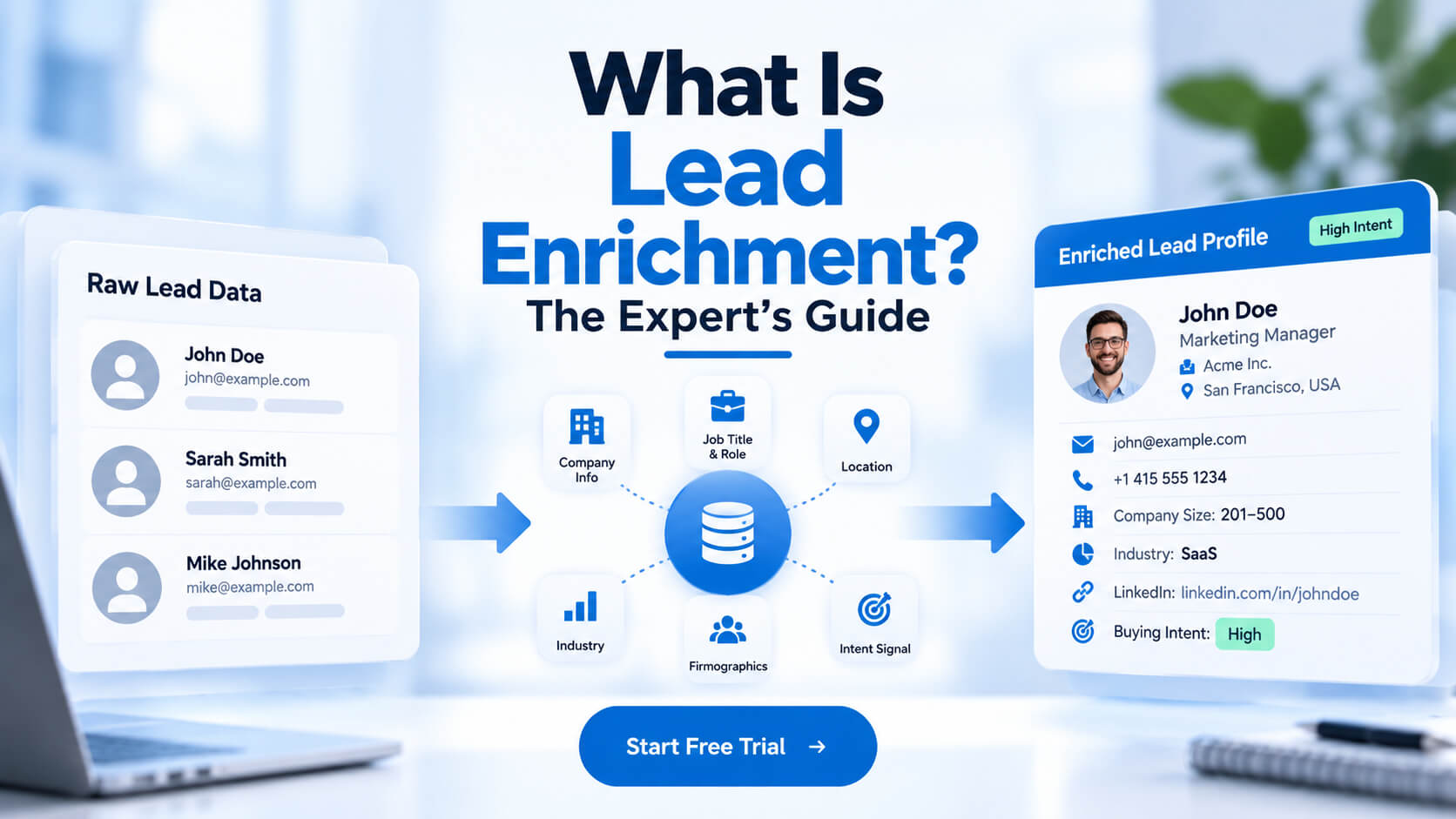
Lead generation gives you names. Lead enrichment puts it in perspective. Even if you have a prospect’s name and email address stored in your CRM, your sales team still has to figure out who they are, where they work, whether they fit your ideal customer profile and how to reach out to them. This is why enrichment is necessary.
It turns incomplete data into meaningful sales intelligence so you can qualify, segment, route and adjust outreach with more confidence. Explore lead enrichment meaning, types and much more.
What Is Lead Enrichment?
So, what is lead enrichment, you ask? It’s the addition of valuable first-party or third-party information to an existing lead record. This might include job title, company, industry, number of employees, location, contact details, tech stack, intent signals, or recent activity.
Lead enrichment is straightforward: you start with a small set of data and add the context your sales or marketing team needs to make better decisions.
You're not treating all contacts the same; you're gathering enough information to determine whether a lead fits your target consumer profile and how you should engage with them.
What Types of Data Can You Add to a Lead?
Not every business needs the same enrichment fields. Focus on data that supports your qualification and outreach process rather than collecting information just because it is available.
- Contact Data
Contact enrichment can include a prospect’s full name, job title, department, work email, phone number, and location. This helps you confirm you are talking to the right person and gives your team contact details to use.
- Firmographic Data
Firmographic information gives you additional information about the firm behind the lead. You may filter by industry, firm size, location, revenue range, website or description of the business.
This is particularly important if your desired client profile is significantly weighted toward organization size, industry or region.
- Technographic and Intent Data
Some B2B teams also supplement leads with information about the technology a firm uses, current business signals, or purchase-intent indicators.
Depending on your data sources, you may also have engagement history or behavioural information to determine whether a prospect is showing higher interest.
Why Does Lead Enrichment Matter for Sales?
Incomplete lead data is busywork. Your salespeople spend time looking up LinkedIn profiles, checking business pages, updating incorrect information, and identifying who genuinely needs attention. Enrichment helps to lessen such friction.
- It Helps You Qualify Leads Faster
With a precise ideal consumer profile, enhanced information makes it easy to compare. A lead's position, company size, location, seniority, or industry can instantly tell you whether the opportunity fits your sales approach. This allows your salespeople to spend more time with stronger prospective prospects.”
- It Makes Personalisation More Relevant
When it is based on real context, personalisation becomes so much stronger. If you know a person’s position, firm, current activity, or business climate, you may tailor your outreach to them, instead of delivering the same generic pitch to every prospect.
- It Improves Segmentation and Routing
Enriched data lets you segment leads by area, industry, firm size, function, seniority, or any other factor.
Instead, you may direct prospects to the correct salesperson or process without examining each new data manually. One practical advantage of enrichment that Workato points to is lead routing.
- It Reduces Manual Research
Without enrichment your team could be hopping between LinkedIn, corporate websites, databases and CRM information for each prospect.
By automating the necessary aspects of that research, you may decrease repetitive labour and help your team go from gathering data to actually selling more quickly.
How Does the Lead Enrichment Process Work?
Lead enrichment works best when it is connected to your broader prospecting or lead-management workflow rather than treated as an occasional CRM cleanup.
- Start With the Data You Already Have
You may start with a form submission, a LinkedIn profile, a prospect list that you’ve imported, an event participant, or an existing record inside your CRM.
- Add the Information You Actually Need
Next, enrichment tools or internal data sources fill relevant gaps. The purpose is not to list all the fields that exist. You want the data that enables you to qualify, segment, route or customise the lead.
- Score and Segment the Lead
Once the data has additional context you may compare it to your ideal client profile. You might find a lead based on tenure, industry, firm size, area, job, or any other parameters that fit your sales strategy. Cognism points to scoring and segmentation as two important processes enhanced lead data may enable.
- Keep Your Lead Data Fresh
Lead information changes constantly. People move companies, job titles change, businesses grow, and contact details become outdated. That is why enrichment should often be an ongoing process rather than something you perform once and forget.
What Should You Look for in a Good Lead Enrichment Workflow?
More data doesn't inherently guarantee better sales statistics. Focus your enrichment process on relevancy, reliability and practical utility for your team.
- Prioritise Important Fields
If your team is primarily qualifying prospects by position, industry, organization size and location, give preference to those fields. Dozens of unnecessary fields merely add to the mess of your database.
- Check Data Quality
Enrichment is only helpful when the data is correct. Don’t trust every field that is returned, but rather design your process with the understanding that the data may be absent, out of date, or may contradict.
- Connect Enrichment to Sales Actions
The value is in what you do with the data. Score, segment, prioritise, route, tailor outreach or follow-up for ICP with richer information. Otherwise, you’re just creating a bigger contact record without improving your sales process.
Conclusion
Lead enrichment may turn a basic prospect record into something your sales team can really use. You know who they are, where they work, if they fit your ICP, and how to approach them, which means less time on research and more time on meaningful engagement.
At Linkziy we’ve implemented lead enrichment within the LinkedIn prospecting flow. You may collect leads from LinkedIn URLs, Sales Navigator searches, posts, groups, events or Linkziy datasets and then enrich those contacts with verified email and phone information. Linkziy AI can also assess profile, business, technology, and activity data and score prospects against your ICP to identify the most promising leads for your attention.
Linkziy brings together prospect collection, enrichment, scoring, sequencing, and reply management in one LinkedIn Growth Operating System, instead of piecing together disparate solutions.
If LinkedIn is the backbone of your outbound strategy, use Linkziy to convert raw profiles into enriched, qualified leads with extra information before you ever send your first message.