Cold Email Reply Rates: A Practical Guide
The five levers that actually move cold email reply rates — deliverability, targeting, openers, follow-ups, response speed — with honest expectations.

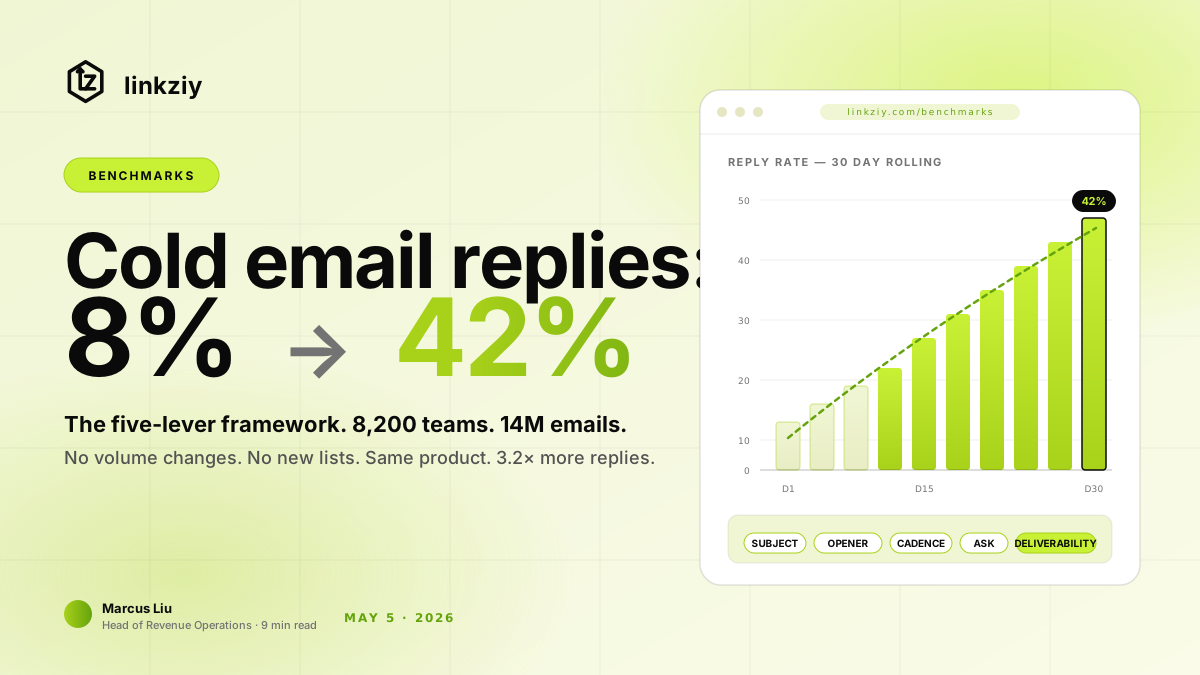
Cold email is the most measurable channel in outbound — sent, delivered, opened, replied, booked — which is exactly why it attracts the most fabricated benchmarks. You have seen the claims: guaranteed 30% reply rates, "one weird subject line," screenshots with the denominators cropped out. We won't add to that pile. What follows is a practitioner's guide to the five levers that actually move reply rates, with honest expectations about each.
Two framing notes first. On numbers: cold email reply rates vary enormously with list quality, offer, and audience — low single digits are common for mediocre campaigns, and well-run campaigns to tight lists do meaningfully better. Nobody can promise you a figure without seeing your list, and you should distrust anyone who does. On us: Linkziy is a LinkedIn-first platform, and much of what follows applies to any outbound channel. If LinkedIn is your primary channel, the companion piece on diagnosing a low LinkedIn reply rate is the more direct read.
Lever 1: Deliverability — the gate in front of everything
No copy improvement matters for an email that lands in spam. Deliverability is unglamorous, mostly technical, and it gates every other lever, which is why it comes first:
- Authentication. SPF, DKIM, and DMARC records on your sending domain. Major inbox providers now effectively require all three for bulk senders; without them you're presumed guilty. Start DMARC in monitoring mode, then tighten the policy once reports look clean.
- Separate your sending domain. Send cold outreach from a lookalike domain, not your primary one, so reputation damage never touches the domain your business runs on.
- Warm up new mailboxes. A fresh mailbox blasting hundreds of emails is a classic spam signature. Practitioners typically ramp new mailboxes over several weeks, starting with a handful of sends a day.
- Keep the list clean. Verify addresses before sending; bounce rates in the low single digits are the practical ceiling before providers start distrusting you.
- Watch volume per mailbox. Keeping each mailbox at modest daily volume and adding mailboxes as you scale is the standard practitioner pattern — the exact safe number varies by provider and domain age, so ramp and observe rather than trusting a magic figure.
Lever 2: Targeting — the cap on your ceiling
The reply rate of a campaign is mostly decided before the first word is written. Email people who genuinely have the problem, at companies showing evidence of it, and average copy performs respectably; email a scraped list of loosely-relevant titles and brilliant copy still underperforms. If your reply rate is low and the replies you do get say "not relevant to us," you have a targeting problem wearing a copywriting costume. The fix is list discipline: a specific ICP, a reason each account is on the list this month, and ruthless pruning of "might as well include them" contacts. Smaller, sharper lists also protect deliverability — irrelevant emails are what generate the spam complaints that sink your domain.
Lever 3: The opener — pass the "is this a template?" test
Readers triage cold email in seconds, and the question they're answering is simple: was this written to me or to ten thousand people? Openers that fail: anything starting with your company, "I hope this finds you well," and mail-merge personalization that any tool can produce ("I see you're the VP of Sales at Acme"). Openers that pass connect something specific and recent about the prospect to a plausible reason for writing — then get to a clear, small point. A useful drafting habit: write the email, delete the first sentence, and see if it got better. It usually does. Keep the whole email short enough to read on a phone without scrolling, make one point, and ask one small question — a reply to a question is a far easier yes than a meeting request.
Lever 4: Follow-ups — where much of the yield lives
Practitioners consistently find that a meaningful share of total replies comes from follow-ups rather than the first email — people are busy, not uninterested, and a well-made second touch catches them at a better moment. But the standard failure mode wastes this lever: "just bumping this to the top of your inbox" adds nothing and reads as pestering. A follow-up structure that respects the reader:
- Touch 2 (a few days later): add something — a sharper angle on the problem, a relevant resource, a one-line insight. No guilt-tripping.
- Touch 3 (about a week on): brief social proof or a concrete example of the outcome you help with, plus a soft ask.
- Touch 4 (one to two weeks on): a graceful close — "should I stop here, or is this worth revisiting next quarter?" Permission-based endings get surprising numbers of replies.
Two to four follow-ups with widening gaps is the broadly-agreed sweet spot; past that, incremental replies skew negative. Running this rhythm reliably across hundreds of prospects is sequencing work — the kind of thing an automated sequence engine exists to keep honest.
Lever 5: Response speed — the lever after the reply
The most neglected lever comes after the reply arrives. Interest decays fast: a prospect who replies "sure, tell me more" at 10am and hears back Thursday has often cooled completely. Speed-to-response is one of the few levers entirely under your control, and teams that treat replies as interrupt-priority — drafts ready to review, one person clearly owning each thread — convert visibly more conversations into meetings than teams that batch their inbox weekly. This gets harder the more mailboxes and channels you run, which is the problem a unified inbox solves: every reply from every account in one queue, so nothing hot sits unanswered.
Putting it in order
If you're improving an existing motion, work the levers in this sequence — each one gates the next:
- Fix authentication, domain separation, and list hygiene (days one to three).
- Cut the list to genuinely qualified prospects (week one).
- Rewrite the opener and shrink the ask (week one to two).
- Replace "bumping this" follow-ups with value-adding touches (week two to three).
- Set up reply routing so responses get answered within hours (ongoing).
Expect improvement to arrive gradually and compound — deliverability fixes show up in a week, targeting and copy changes over a month. Anyone promising a specific multiple in thirty days is guessing with confidence.
FAQ
What's a good cold email reply rate?
It depends too much on audience and offer for a single honest number. Low single digits are common; tight lists with strong relevance do considerably better. The workable approach: measure your own baseline over a few hundred sends, then judge changes against it.
Should I do cold email or LinkedIn outreach?
They're complementary, not rivals. Email scales further per unit effort; LinkedIn messages land in a less crowded, higher-context channel and let prospects inspect who you are. Many teams run both, using each channel's strengths — and coordinating them from one place is much of the point of a multi-channel workspace like Linkziy.
How many follow-ups is too many?
Most practitioners cap at three or four total touches with widening gaps. Beyond that, extra replies skew negative and the spam-complaint risk to your domain outweighs the marginal meeting.
Do open rates still matter?
Less than they used to. Privacy features inflate and distort open tracking, so treat opens as a rough deliverability signal at best. Replies and meetings are the metrics worth steering by.
Where to start
Start with deliverability — it's the least glamorous lever and the one that gates all the others. Then shrink the list, sharpen the opener, upgrade the follow-ups, and answer replies fast. If your outbound runs through LinkedIn as well as email, start a free 14-day Linkziy trial — sequences, reply management, and lead data in one workspace, no credit card required.